
TripBuddy Guide
Vienna looks compact on a map — a grand old center wrapped in a ring road, with numbered districts spiraling outward — but where you sleep changes the trip. Stay inside the Ring and you walk out of your hotel into imperial Vienna: palace facades, coffee houses, the cathedral. Stay a district or two out and you get the Vienna people actually live in — market streets, neighborhood bakeries, and rates that leave room in the budget for a second slice of Sachertorte.
The U-Bahn is fast, clean, and easy to read, so almost no district is a bad base. The real question is what you want your mornings and evenings to look like — especially in Christmas market season, when the city effectively reorganizes itself around a dozen squares of lights, stalls, and mulled wine.
Sign up for monthly travel guides
The short answer
- First trip, sightseeing focus: the Innere Stadt (1st district) — every headline sight on foot, the most grand hotels, the highest prices.
- Christmas market trips: the Innere Stadt or the Rathaus/Josefstadt side of the Ring, so the biggest markets are a walk, not a commute.
- Food, cafés, and a local feel: Neubau (7th) around Spittelberg, or Landstraße (3rd) for a quieter version.
- Families: Josefstadt for calm streets near the center, or out by Schönbrunn for space and the palace market.
- Budget travelers: Leopoldstadt (2nd) across the canal, or near a U-Bahn station in Landstraße — central Vienna without central prices.
Innere Stadt: the classic downtown base
The 1st district is the Vienna on the postcards: St. Stephen's Cathedral, the Hofburg palace complex, the State Opera, and the Graben shopping streets, all inside the Ringstrasse boulevard. Hotels here skew grand and historic — this is where the famous five-stars sit — but there are smaller pensions tucked down side lanes if you dig.
Stay here if: it's your first visit, your trip is short, or you want to walk everywhere and ride transit barely at all. In market season you're also on top of several markets at once: Stephansplatz by the cathedral, Am Hof, and the Freyung are all in the old town.
Know before you book: this is the priciest district in the city, and the headline rate is rarely the final one — breakfast charges, city tax, and parking (if you somehow bring a car) stack up fast. Our resort fees guide covers the add-on trap in detail: it applies in Vienna's grand hotels just as much as in Las Vegas.
Rathaus and Josefstadt: flagship market territory
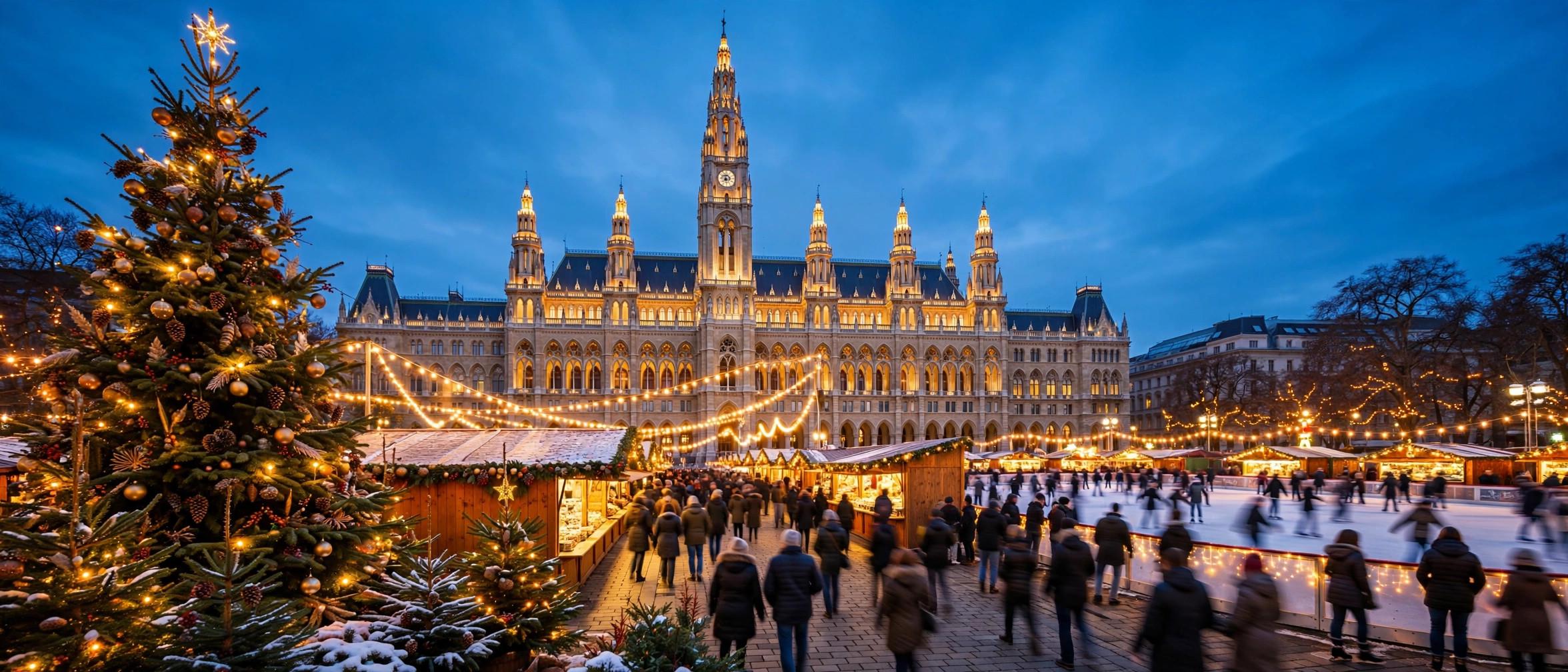
Cross the Ring northwest of the old town and you hit the Rathaus — Vienna's neo-Gothic City Hall — and behind it the quiet, residential 8th district, Josefstadt. This is grand-hotel country along the Ring itself, with calmer, more local streets a block or two back.
Stay here if: the Christmas markets are the point of your trip. The Wiener Christkindlmarkt on Rathausplatz is the city's flagship — the biggest market, the tallest tree, an ice rink that winds through the park — and the Christmas Village on Maria-Theresien-Platz, between the two big museums, is a ten-minute stroll south. Josefstadt's small hotels and apartments suit travelers who want that access without sleeping inside the crowds.
Know before you book: Ring-facing rooms can be noisy and the immediate Rathausplatz area is wall-to-wall people on December weekends. A hotel one or two streets back in Josefstadt gives you the same walk to the stalls and a much quieter night's sleep.
Neubau and Spittelberg: creative, local, market-lined lanes
The 7th district, Neubau, is Vienna's creative quarter — design shops, galleries, vintage stores, and the MuseumsQuartier complex anchoring its eastern edge. Inside it, the little Spittelberg neighborhood is a preserved pocket of narrow Biedermeier lanes that feels like a village that wandered into the city.
Stay here if: you travel for neighborhoods rather than monuments, prefer boutique hotels and apartment-style stays, or you're coming in market season and want a different flavor of it — Spittelberg's Christmas market threads its stalls through those lanes, leans craft and food over souvenirs, and is where Viennese actually meet friends after work.
Know before you book: hotel supply is thinner here and the best small properties book out earliest for December weekends. You're still an easy walk or one U-Bahn stop from the Ring sights, but the walk to the cathedral runs about 20 minutes — close, not step-outside close.
Landstraße and Karlsplatz: the practical middle
Southeast of the center, the 3rd district (Landstraße) and the streets around Karlsplatz are Vienna's sensible middle ground: solid mid-range hotels, the Belvedere Palace and its gardens at the top of the district, and Stadtpark's green space along the Ring. It's less storied than the 1st district and noticeably cheaper for it.
Stay here if: you want a good hotel at a fair price, you're arriving by train (Wien Mitte station is here, with the direct airport train), or you're staying several nights and want a real neighborhood around you.
Know before you book: for a longer stay, an apartment hotel in Landstraße often beats a small central double on both space and cost — the math in our extended stay vs. regular hotel comparison applies directly. In market season, Karlsplatz hosts Art Advent, an arts-and-crafts-focused market in front of the Karlskirche, an easy evening walk from most of the district.
Sign up for monthly travel guides
Leopoldstadt: across the canal, easier on the wallet
The 2nd district sits across the Danube Canal from the old town — historically its own world, today a mix of the Prater park, the Karmelitermarkt food market streets, and growing numbers of newer hotels along the canal. Downtown is one U-Bahn stop or a ten-minute walk over the bridge.
Stay here if: you're on a budget, traveling with kids who'd enjoy the Prater's open space and Giant Ferris Wheel, or you like a morning market on your street. In winter the Prater hosts a Wintermarkt by the Ferris Wheel that runs later into the season than most.
Know before you book: the district is big, and "Leopoldstadt" on a listing can mean a long walk from the canal — check the actual map pin and the nearest U-Bahn station before you book, not just the district name.
Schönbrunn and Hietzing: the palace as your local landmark
Out west in the 13th district, the streets around Schönbrunn Palace are leafy, calm, and residential — Vienna at its most suburban, in the best sense. Hotels are fewer and simpler, and the palace gardens become your morning walk.
Stay here if: you're a repeat visitor, traveling with kids, or coming for the markets and want the prettiest one as your home base — the market in the palace forecourt is many people's favorite, and it runs the longest season in the city.
Know before you book: the center is a straight U4 ride of about 15–20 minutes, which is nothing at noon and feels longer at 11 p.m. in December cold. Treat this as a destination base for a palace-and-markets trip, not a base for nightly old-town dinners.
A word on season — Christmas markets redraw the map
If you're coming between early November and New Year, the markets are not a side activity; they're the main event, and they should drive where you stay. The 2026 season opens in stages: the first markets (Schönbrunn and Stephansplatz) start November 6, the flagship Rathausplatz Christkindlmarkt opens November 13 and runs to December 26, and most of the rest switch on across that same mid-November stretch. One trap to plan around: many of the smaller markets — Spittelberg, Freyung, Am Hof, Karlsplatz — close for good on December 23, while Rathausplatz and Stephansplatz run through December 26 and Schönbrunn and the Prater Wintermarkt keep going to January 6. Staying within a cold-evening walk of the Innere Stadt and Rathausplatz means you can do a market as an after-dinner stroll instead of a planned expedition. Outside market season, the same logic inverts: in summer, pay for the districts with gardens, park access, and evening life (Neubau, Josefstadt, the canal side of Leopoldstadt) rather than the ceremonial center.
How to choose, in one pass
- 1. Short first trip? Innere Stadt. Pay for centrality, walk everywhere.
- 2. Coming for the markets? Innere Stadt or Josefstadt near Rathausplatz — walking distance beats a cold commute.
- 3. Local flavor, boutique hotels? Neubau and Spittelberg.
- 4. Fair price, longer stay, train arrival? Landstraße.
- 5. Tight budget or kids in tow? Leopoldstadt near a U-Bahn station, or Hietzing if the palace is your headline.
TripBuddy may earn a commission when you book through links on this page, at no extra cost to you.
Comparing Vienna hotels and want a second set of eyes on the district trade-offs? Start with our hotel hub for how we think about booking, or talk to a TripBuddy advisor before you lock in a nonrefundable rate.
Last reviewed: October 19, 2026