
TripBuddy Guide
San Francisco fits inside seven square miles and still feels like five different cities. Your neighborhood decides whether your days glide between sights or turn into uphill marches. In most cities, picking a hotel is a price decision. In San Francisco, it's geography.
Here's the honest take first: there is no single "best" area in San Francisco. There is only the best area for your trip. A first-timer, a family needing flat ground, a food-first couple, and a traveler catching a 6 AM flight out of SFO should stay in four different neighborhoods. This guide matches areas to trip styles — and tells you the tradeoffs nobody puts in the brochure. Fair warning: the hills are real, the fog has a personality, and transit is a patchwork — we'll cover all of that honestly after the neighborhoods.
Sign up for monthly travel guides
The short answer: match the area to your trip
- First-timers who want the greatest hits: Union Square — central, walkable to cable cars, theaters, and downtown sights.
- Families or travelers who need flat ground: Fisherman's Wharf — calm, level streets, right by the bay attractions.
- Food, bars, and going out: the Mission (Valencia Street corridor) or SoMa — the city's best eating and latest nights.
- A quieter, residential base: the Marina or Cow Hollow — tree-lined, flat, pretty, with Golden Gate views at Crissy Field.
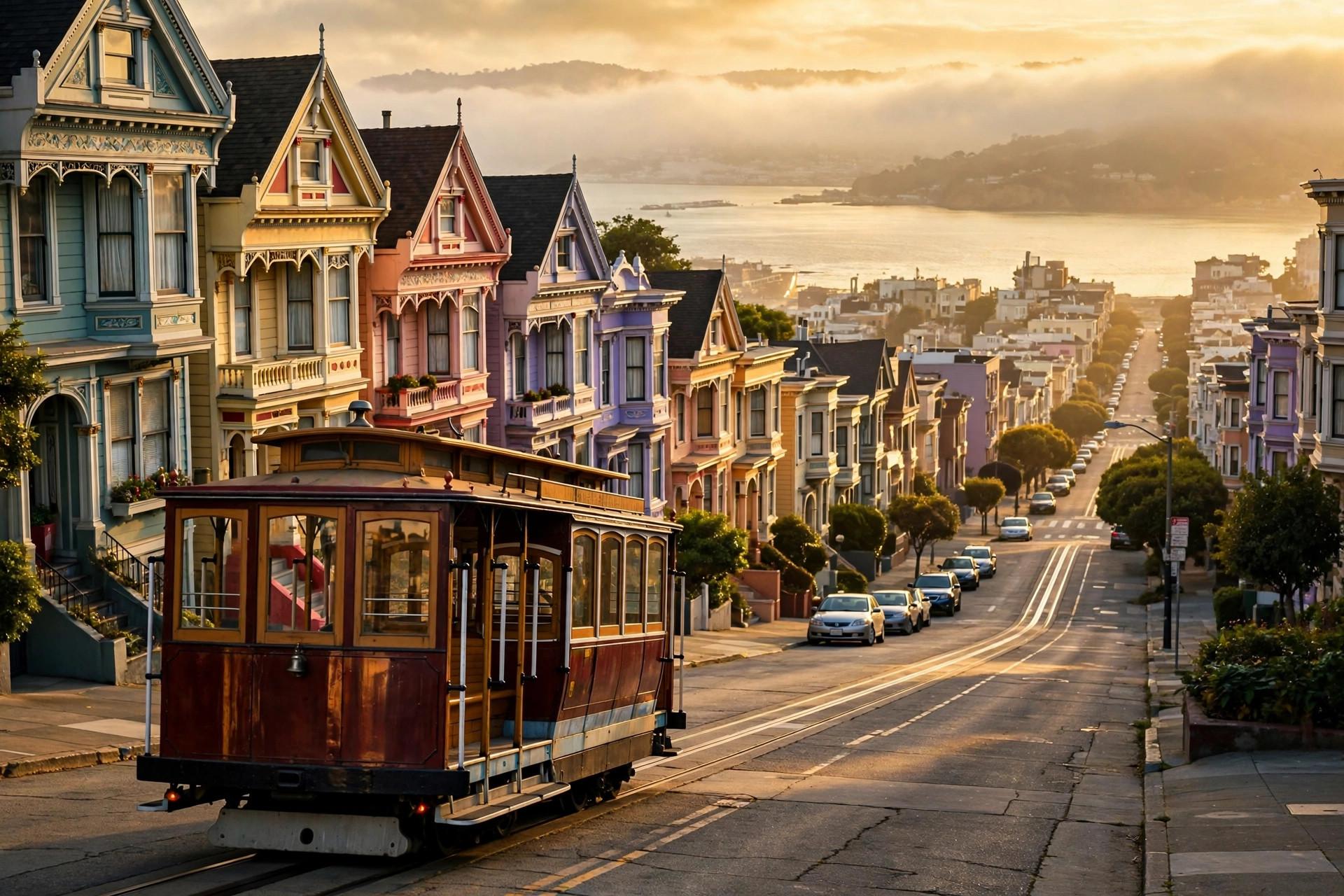
- Hilltop views and cable-car romance: Nob Hill — grand old hotels above the city, if your legs are up for it.
- Late arrival or early flight: near SFO (Burlingame or South San Francisco) — practical, usually cheaper, and BART gets you downtown anyway.
If you remember nothing else: respect the hills, stay near transit you can actually use, and know that the loudest version of "downtown" is rarely the most pleasant one.
Union Square: the classic first-timer base
Union Square is the city's commercial heart — department stores, the theater district, the Powell Street cable car turnaround, and the BART and Muni stations that connect you everywhere. For a first visit with three or four days, it's the most efficient base: walk to the cable cars, ride downtown transit in any direction.
Stay here if: it's your first visit and you want the greatest hits within reach, you like a buzzing downtown base, or you're in town on business during the week.
Know before you book: the neighborhood changes character fast — the Tenderloin sits just west, and a few blocks make a real difference (more on safety below). Choose your specific block carefully, not just the "Union Square" label. Street noise is real on the busier corners.
Fisherman's Wharf: the family pick
The Wharf is flat, walkable, and built for visitors: sea lions at Pier 39, Ghirardelli Square, the cable car terminus at Hyde and Beach, and easy ferries to Alcatraz and Sausalito. If anyone in your group has limited mobility, small kids, or a stroller, the flat ground alone may settle the decision.
Stay here if: you're traveling with kids, you want calm evenings and bay air, or your sightseeing centers on the waterfront.
Know before you book: this is the most tourist-oriented part of the city — restaurants skew toward the tourist-priced, and it can feel disconnected from the San Francisco locals actually live in. Evenings wind down early. If you're driving, parking near the Wharf is expensive — factor it into your comparison, not after.
The Mission and SoMa: food, bars, and going out
The Mission is where San Francisco eats and stays out late — taquerias and destination restaurants along Valencia Street, murals in Clarion Alley, crowds in Dolores Park on sunny afternoons. SoMa (South of Market) is the newer, loftier counterpart: the ballpark and the big museums. Together they hold the city's contemporary pulse.
Stay here if: food drives your itinerary, nightlife matters, or you want the city as it is now rather than the postcard version.
Know before you book: parts of the Mission near the 16th and 24th Street BART stations are gritty, especially after dark — the vibe shifts block by block, so read recent reviews of your exact location. Valencia Street is loud late; light sleepers should ask for a room off the main drag.
The Marina and Cow Hollow: the quiet residential base
Tree-lined streets, the shops and cafés of Chestnut Street, the Palace of Fine Arts, and Crissy Field's postcard view of the Golden Gate. The Marina is flat, pretty, and calm — the San Francisco you move to, not the one you tour.
Stay here if: you want quiet nights, morning runs with a bridge view, a couples' trip, or you've been before and don't need downtown.
Know before you book: BART doesn't come here — you're on buses and Muni streetcars, and getting downtown takes a while. It's lovely and sleepy — perfect or boring, depending on the traveler.
Nob Hill: hilltop views and cable-car romance
The grand dame of San Francisco neighborhoods — the Fairmont, the Mark Hopkins, Grace Cathedral, cable cars gliding past your window. Nob Hill is the splurge base: old-world hotels, top-floor bars, and the city spread out below you.
Stay here if: the trip is a splurge, an anniversary, or a honeymoon — or you simply want the classic San Francisco postcard from your room.
Know before you book: those hills are not decorative. Walking back up to Nob Hill from downtown is a genuine workout. This is a base for people happy to ride the cable car, take a taxi uphill, or treat the climb as character-building. Prices run high, and "city view" can mean a sliver between buildings — read the room descriptions carefully.
Near SFO: the smart move for late arrivals
If your flight lands after 10 PM or departs before 7 AM, do the math on staying near the airport instead of dragging luggage downtown at midnight. Burlingame and South San Francisco hold the airport hotel cluster — practical and usually cheaper, and BART connects SFO to downtown in about half an hour, so you can still sightsee without sleeping there.
Stay here if: you're arriving late, leaving early, or San Francisco is a one-night stop on a bigger trip.
Know before you book: this is suburbia — perfectly fine for a night, nobody's idea of a destination. If your trip is mostly in the city, don't trade three days of commuting for one convenient airport night.
The honest San Francisco stuff: hills, fog, transit, and safety
Here's the unvarnished version, all in one place.
The hills. San Francisco has some of the steepest urban streets in the country, and your base's elevation matters as much as its location. Wear real shoes, and budget for the occasional uphill taxi — a legitimate strategy, not a failure. If mobility is a concern, the flat neighborhoods (the Wharf, the Marina) aren't just nice, they're necessary.
The fog. There's an old joke that the coldest winter is a San Francisco summer, and there's a reason it survives: summer can be foggy, windy, and genuinely chilly, especially near the water. Microclimates are real — it can be warm and sunny in the Mission while it's gray at the Wharf. Pack layers year-round.
Transit. Each system does a different job, so match your base to the one you'll actually use. BART connects SFO and the East Bay to downtown along Market Street — fast and useful, but it doesn't reach Fisherman's Wharf, the Marina, or Golden Gate Park. Muni buses and streetcars fill the gaps. Cable cars are an attraction, not a commute: slow, crowded, and the single-ride fare costs noticeably more than a regular Muni ride. A Clipper card covers BART and Muni.
Safety. Let's be candid: parts of downtown — especially the blocks where Union Square, the Tenderloin, Civic Center, and parts of SoMa meet — have visible homelessness and open drug use that can unsettle first-time visitors. The blocks change fast, which is why your exact location matters more than the neighborhood name. Violent crime targeting tourists is rare, but property crime is not: never leave anything visible in a parked car — break-ins are the city's most common visitor crime. At night, stick to busy, well-lit streets.
Sign up for monthly travel guides
How to choose: five questions that settle it
Still torn between two areas? Run through these:
- How many nights? Three or fewer — stay central (Union Square). A week — the Mission or Marina start paying off as a lived-in base.
- First visit or return? First visit — Union Square or the Wharf for the greatest hits. Return trip — the Mission or Marina for the city behind the postcard.
- How are you arriving? Landing late or leaving early — stay near SFO that night. Driving in — parking costs matter more than the nightly rate; see the booking tips below.
- Legs and luggage? If hills are a problem, the Wharf and the Marina are flat. Skip Nob Hill, and check the elevation of any "downtown" hotel before you book, not after.
- What time do you go to bed? Before midnight — avoid Valencia Street in the Mission and the loudest Union Square corners. After — anywhere works.
Booking tips for San Francisco specifically
A few local quirks worth knowing before you click book:
- Book early for summer and big events. Summer is peak season, and major events — Fleet Week, Dreamforce, big concert weekends — can send downtown rates spiking. Our guide to when to book your hotel covers timing strategy in more detail.
- Compare the total, not the headline. San Francisco hotel taxes are steep, and they stack on top of the nightly rate — a meaningful percentage that never appears in search results. Our hotel price comparison guide walks through reading a rate the way hotels price it.
- Price parking like a room upgrade. If you're driving, nightly parking at downtown and Wharf hotels is a real line item — always check it before comparing, because a "cheaper" hotel with steep parking often isn't.
TripBuddy may earn a commission when you book through links on this page, at no extra cost to you.
Once you've picked your neighborhood, take the next step — start planning your San Francisco stay on TripBuddy's hotels page for more neighborhood guidance, and if you'd rather have a person sort out the details, a TripBuddy travel advisor can match your base to your actual itinerary.
Last reviewed: October 12, 2026