
TripBuddy Guide
Istanbul is not a city where you can pick the wrong neighborhood and shrug it off. It’s a sprawling metropolis of 16 million people stretched across two continents, and traffic across the Bosphorus can eat two hours of your day without trying. Pick right, and you’re sipping tea on a rooftop above the minarets ten minutes after you wake up. Pick wrong, and your “quick dinner in Kadıköy” becomes a logistical project.
The good news: Istanbul’s neighborhoods have genuinely distinct personalities, which makes the choice clearer than in most big cities. This isn’t a “best neighborhood” ranking — there isn’t one. It’s a matching exercise. Tell me your trip style, and I’ll tell you where to sleep.
One honest caveat up front: hotel prices in Istanbul swing hard with the season. Spring and early autumn are the sweet spots for weather and availability; summer and the holiday weeks are peak. Whatever neighborhood you choose, book refundable rates when you can — our guide to decoding hotel cancellation policies explains why.
Sign up for monthly travel guides
The short answer: match your neighborhood to your trip
- First-time visitor who wants the postcard Istanbul? Sultanahmet. Walk to everything on day one, accept that the restaurants are tourist-priced.
- Nightlife, bars, and a late-night city? Beyoğlu, around Taksim and Istiklal Street. The city that never sleeps, for better and worse.
- Food lover or boutique-hotel fan? Karaköy and Galata. Historic streets, rooftop bars, and the city’s best eating density.
- Want to feel like a local? Kadıköy on the Asian side. Market streets, meyhanes, and hardly a tour group in sight.
- Flying in late or out early? Read the airport section below before you book anything. IST and SAW are not interchangeable.
Sultanahmet: the postcard, with tradeoffs
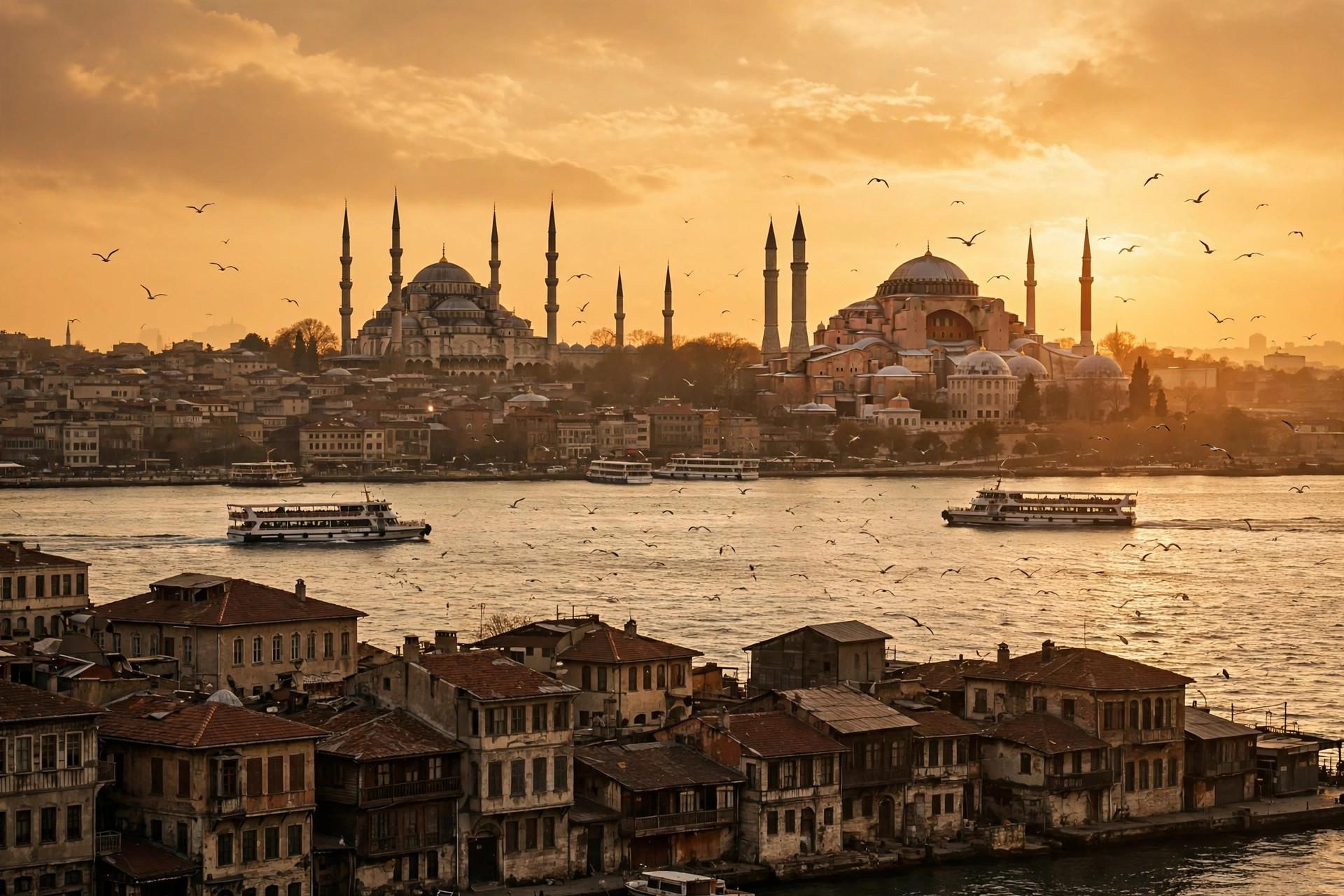
Sultanahmet is the old city — the peninsula where the Hagia Sophia, Blue Mosque, Topkapı Palace, Basilica Cistern, and Grand Bazaar all sit within a half-mile of each other. If your trip is three days and you want maximum sightseeing with minimum transit, this is your neighborhood. You can step out of your hotel and walk to a world wonder in five minutes, and the evening call-to-prayer view from the rooftop terraces is genuinely special.
What it’s not: lively at night. After the day-trippers and tour buses leave, Sultanahmet goes quiet — the dining scene is built for tourists, and locals don’t come here to eat or drink. Trams are your friend here; the T1 line connects Sultanahmet to the ferry piers and the newer parts of town cheaply and reliably.
Hotels here range from small family-run Ottoman-style guesthouses in converted townhouses to a handful of genuinely luxurious historic hotels. Watch the room descriptions carefully: “historic building” often means charmingly irregular — small windows, steep stairs, no elevator. If stairs or noise are an issue for you, check before you book, not after.
Beyoğlu and Taksim: energy around the clock
Across the Golden Horn from Sultanahmet, Beyoğlu is the modern city’s pulse: Istiklal Street’s pedestrian crowds, Pera’s art galleries, side-street bars that fill up at midnight, and Taksim Square as the transit hub everything connects to. If your trip is about nightlife, live music, and people-watching, stay here and you’ll never be more than a short walk from the action.
The honest tradeoff is noise and polish — or lack of it. Beyoğlu is a real, working district, not a curated quarter. Istiklal Street on a Saturday night is electric and packed; it can also be exhausting, and the streets around Taksim are gritty in the way big-city centers are. Hotels here are excellent value for what you get, though: modern mid-range and business hotels cluster around Taksim, and the competition keeps quality honest.
Logistically, Beyoğlu is the city’s transit sweet spot. Metro lines, the funicular down to the ferry at Kabataş, and the airport metro connections all funnel through here — which is exactly why it’s also the best base if you’re on the Asian side for a day trip and want an easy return.
Karaköy and Galata: the foodie’s base
Karaköy was Istanbul’s old port district — gritty warehouses and ship supply shops. Over the last decade it’s become the city’s eating and boutique-hotel corridor: coffee roasters, fish restaurants along the water, rooftop bars under the Galata Tower, and some of the most characterful small hotels in the city.
Galata itself, climbing the hill to the 14th-century tower, is steep — gloriously, calf-burningly steep. The payoff is atmospheric cobbled lanes and rooftop views over the Golden Horn. This is the neighborhood for travelers who want to wander and graze: you can build an entire day out of “walk downhill toward the water and eat whatever smells good.”
Accommodation here skews boutique and design-forward, and it’s where Istanbul’s hotel scene shows its best value — well-designed rooms at prices that would buy you half as much in Sultanahmet’s luxury tier. The downside: streets can be loud late on weekends, and some of the cheapest options are on streets better navigated after dark with company. Read the reviews of the specific street, not just the property.
Sign up for monthly travel guides
Kadıköy: the local Istanbul
Kadıköy is where the matching exercise gets interesting. This is the Asian side’s main hub — a district of market halls, bookshops, meyhanes (taverns), and coffee houses where Istanbulites actually spend their evenings. Tourists are thin on the ground, the food is cheaper and better than in the tourist quarters, and the famous Moda waterfront promenade is where locals go to watch the sunset.
The catch is access. Kadıköy is a ferry ride away from the European-side sights — a beautiful 20-minute crossing from the Kadıköy pier to Karaköy or Eminönü, but a crossing you have to plan around. Ferries run frequently during the day and thin out at night, and the metro across the Bosphorus (the Marmaray line) takes over after dark. Staying here works best for longer trips (a week or more) where you’ve already seen the big sights, or for a second visit when the novelty of sleeping in Asia appeals.
Honestly, though, there’s a quiet argument for Kadıköy even on a shorter trip if your Istanbul days are food-first. The Tuesday and Friday produce markets alone are worth planning a trip around, and the restaurant density on Caferağa and Moda streets rivals anywhere in the city.
The honest truth about Europe vs. Asia
Staying “in Asia” sounds exotic, and it is — for about a day. The practical reality is that nearly everything a first- or second-time visitor wants to see (Hagia Sophia, Blue Mosque, Grand Bazaar, Galata Tower, Istiklal, the Bosphorus cruise docks) is on the European side. Each crossing costs you 30–60 minutes of planning overhead, door to door.
So here’s the principle: sleep on the European side unless you have a specific reason not to. “Specific reasons” that hold up: your flights are through Sabiha Gökçen on the Asian side, you’re on a long trip and want a change of scenery, or you’re returning for a food-focused visit. Don’t choose the Asian side just for the bragging rights — you’ll spend those rights in transit.
Airport access: the section that can save your trip
Last reviewed: October 12, 2026.
Istanbul has two airports, and choosing your hotel neighborhood without checking your airport is the single most common planning mistake here. Istanbul Airport (IST), the big one on the European side, sits about an hour from the city center by metro or shuttle. Sabiha Gökçen (SAW), the budget-carrier airport, is on the Asian side — reaching Sultanahmet from SAW can take two hours or more in bad traffic.
The principle-based advice: match your neighborhood to your airport. Flying into IST? Sultanahmet, Beyoğlu, and Karaköy all work, with Beyoğlu’s Taksim hub giving you the simplest late-night transfer options. Flying through SAW? Seriously consider Kadıköy or Üsküdar on the Asian side — the transfer drops to minutes instead of hours, and you’ll thank yourself at 1 AM.
If you have a very early departure or a red-eye arrival, one night at an airport hotel is often the smartest move, not a waste of a night. Booking two hotels across a single trip (airport night + city nights) beats burning half a day in traffic. This is also where arrival timing matters more than most cities: landing at IST at 11 PM with a SAW departure next morning is a recipe for a ruined first day.
TripBuddy may earn a commission when you book through links on this page, at no extra cost to you.
If the Europe-vs-Asia question, the airport logistics, or the neighborhood matching feels like a lot to puzzle through alone, you don’t have to: plan your Istanbul stay with a TripBuddy travel advisor — we’ll match your itinerary, flights, and trip style to the right neighborhood before you commit to anything nonrefundable. (Note: our hotels page currently has no self-serve booking widget — the advisor service is the way to get a tailored plan.)
The bottom line for your first trip
If I had to give one answer: spend your first three to four nights in Sultanahmet or Karaköy, walk everywhere, take the ferry to Kadıköy for a full day and evening, and finish with a Bosphorus cruise — which you can book on our activities page — sailing back as the minarets go gold. That’s the postcard Istanbul, and the postcard exists for a reason.
Then, if you get the longer trip or the return visit, stay in Kadıköy, eat where the locals eat, and realize the city has a second life you’ve been missing. And if you’re still weighing where to fly in, our flights guide covers how to time and choose your arrival.
Ready to stop guessing on neighborhoods? Book a planning session with a TripBuddy advisor and we’ll build your Istanbul itinerary — right side of the Bosphorus, right airport transfers, right hotel — around the trip you’re actually taking.