
TripBuddy Guide
Sicily rewards drivers and punishes drivers in roughly equal measure. A car unlocks the southern coast, the Valley of the Temples, hill towns no bus reaches, and the freedom to stop wherever the view demands it. It also delivers you into medieval streets built for donkeys, parking systems with their own color code, and automatic fines from cameras you never noticed. This guide answers the practical questions first-timers actually ask — the restricted zones, the parking lines, the roads, the pickup logistics — so you can decide before you fly whether the car is a help or a headache.
Sign up for monthly travel guides
The short answer: the five things that matter most
- ZTL zones are the fine machine. Historic centers in Palermo, Taormina, Syracuse/Ortigia, and others restrict non-resident traffic; cameras fine you automatically. This is the single most expensive mistake renters make.
- Parking lines are a code. Blue lines mean paid parking, white lines mean free, yellow lines mean reserved — park in the wrong color and you’ll be ticketed or towed.
- The car should be small. Narrow one-way streets and tight old-town parking reward the smallest car you’re comfortable in. Size down from what you’d pick at home.
- Manuals are the default. Automatics exist but cost more and sell out first — reserve early if you need one.
- Fuel policy is full-to-full. Pick up full, return full, and find the return-area station before you leave for the airport.
Get those five right and Sicily by car is genuinely wonderful. Get the first one wrong and it’s genuinely expensive.
ZTL zones: the restricted-traffic trap
ZTL stands for Zona Traffico Limitato — limited traffic zone — and it covers the historic centers of most Sicilian towns and cities. Only residents, registered vehicles, and authorized drivers may enter during restricted hours; everyone else gets photographed by cameras at the zone entrances and fined by mail, weeks after you’re home. There is no officer waving you down, no warning — just a letter from the rental company forwarding the fine, plus their own administrative fee for looking up your address.
This is the number-one renter surprise in Sicily, and the rental counter will not reliably warn you about it. What to do:
- Ask your hotel. Most hotels inside or near a ZTL can register your plate for access during your stay. This is the single most important sentence in this article: email the hotel before you arrive and ask about ZTL access and parking. They do this for guests constantly.
- Watch for the signs. ZTL entrances are marked with a white circle with a red border and the letters ZTL, plus the restricted hours. If you see one ahead and you haven’t arranged access, stop and reroute — restricted hours vary by town, so don’t assume one town’s rules apply to the next.
The catch nobody mentions: navigation apps will happily route you through a ZTL because it’s the shortest path. The app doesn’t know you’re not a resident. Trust the signs over the screen in old towns.
Our editorial judgment: if your trip is mostly historic-center bases (Palermo, Taormina, Ortigia), the ZTL stress alone is a legitimate reason to skip the car and use trains. The car earns its keep on the between — the southern coast, Agrigento, the interior — not in the old towns.
Parking: what the line colors mean
Italian parking runs on a color code painted on the curb. Learn it once and you’ll read every Sicilian street correctly:
- Blue lines (strisce blu): paid parking. You pay at a nearby machine or via a parking app, display the ticket on the dashboard, and respect the time limit shown. Rates and hours are posted on the machine — read them, because enforcement is active and fines are real.
- White lines (strisce bianche): free parking. First come, first served. In practice these fill early in popular towns, especially near beaches in summer.
- Yellow lines (strisce gialle): reserved — residents, disabled permit holders, loading zones, taxis. Not for you, ever. Parking here risks a tow, not just a ticket.
Practical notes: in historic hill towns, legal parking is often outside the center with a walk (or shuttle) in — factor that walk into your evening plans. At beaches, follow the blue lines near the lot entrances; the “free” spots locals use on verges and shoulders are where rental cars collect damage and tickets. And when you park on a street, photograph where you left the car and the parking lines around it — if a ticket appears, you’ll want evidence of the markings.
The streets: narrow, one-way, and occasionally theatrical
Sicilian old towns were built centuries before cars, and they show it: one-way systems that fold back on themselves, streets where your mirrors nearly touch both walls. It’s normal driving here, not an emergency — but it rewards a specific approach:
- Rent small. A compact car is not a compromise in Sicily; it’s the correct tool. Everything about parking, turning, and squeezing through old-town streets gets easier with less car around you.
- Mirrors in. Fold your mirrors in tight streets and when parked on narrow lanes. This is what locals do.
- Scooters are everywhere. They will pass you on both sides, at speed, in places that don’t look like lanes. Expect it, don’t swerve at it — and keep your own speed down. The drivers who get into trouble in Sicily are the ones driving at home speed on holiday roads.
- Hill towns mean gradients. Taormina, Erice, and their cousins sit on cliffs. The roads up are winding and narrow; take them slowly, use pullouts to let locals pass, and never stop on a blind curve for a photo.
None of this is dangerous if you slow down and stay predictable. The drivers who get into trouble in Sicily are the ones driving at home speed on holiday roads.
Sign up for monthly travel guides
Autostrada vs smaller roads: pick your trade-off
Sicily’s road network has two personalities:
- The autostrada (A-series highways) connects the major corridors — Palermo to Catania, Messina to Syracuse. It’s tolled, fast, and uneventful. Pay tolls at booths with cash or card; keep the ticket from entry to exit on ticketed stretches. The honest trade-off: you save real time (Palermo–Catania is roughly three hours) but see nothing of the island between exits.
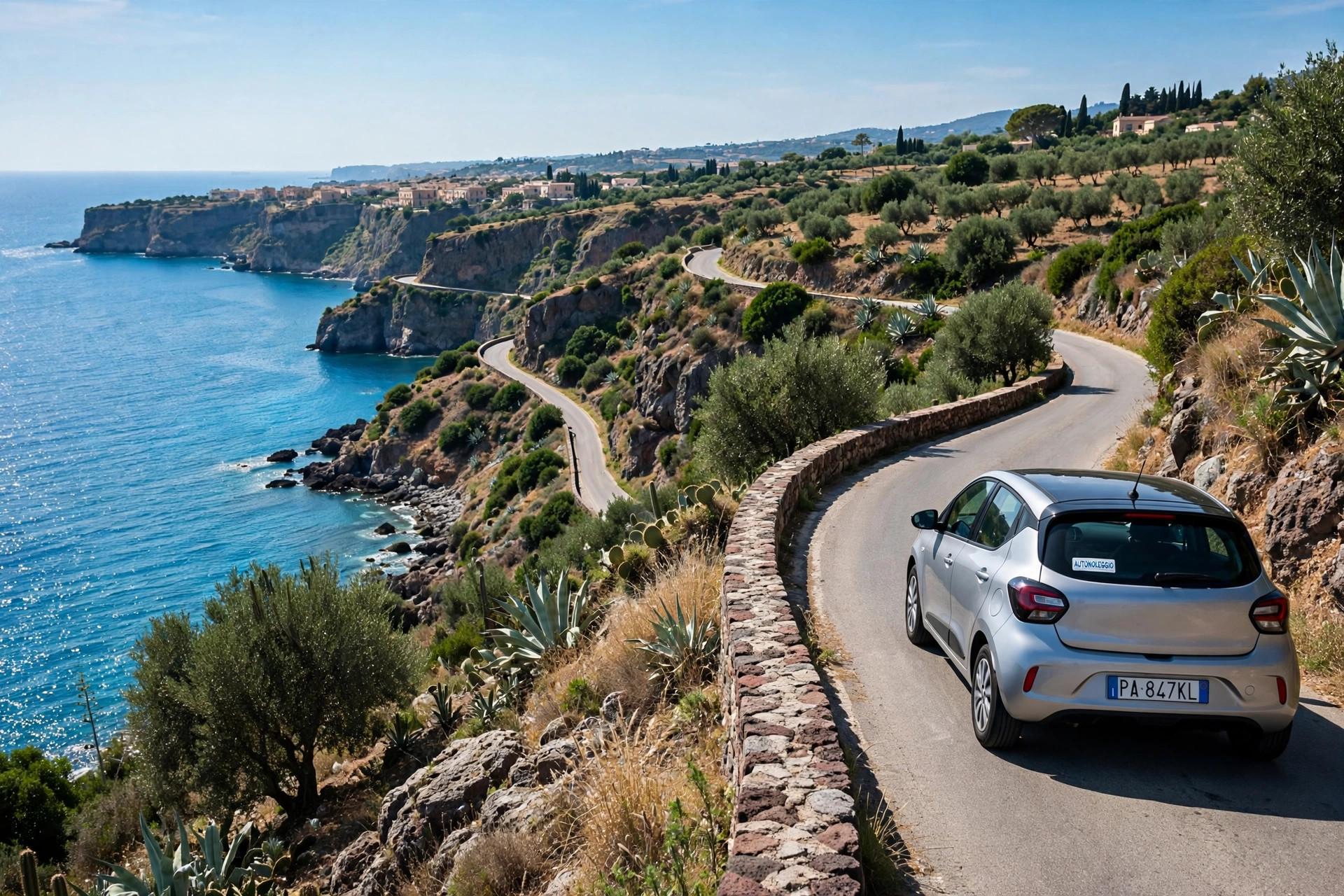
- The SS and SP roads (state and provincial) wind through the interior and along the coasts. They’re free, scenic, and slow — a distance that looks like an hour on the map can take two once the road starts switchbacking through hill towns. This is where the Sicily you came for lives.
The practical framework: autostrada for transit days, smaller roads for days when the drive is the activity. Taking the back roads on a moving day is how you arrive after dark — plan moving days on the fast roads, sightseeing days on the slow ones.
Download offline maps before you leave wifi; rural coverage on the smaller roads can be patchy.
Manual vs automatic: book the automatic early
Here’s the fact first-timers most often learn at the counter: the European rental fleet is overwhelmingly manual transmission. Automatics exist at every major Sicilian rental location, but in smaller numbers — and in summer they book out weeks ahead.
What that means for you:
- If you drive manual, you’ll have the widest choice and the lowest rates.
- If you need an automatic, reserve it as early as you book the trip — not as an afterthought. Showing up hoping for an automatic in August is a gamble you’ll likely lose.
- Automatics cost more. Expect a meaningful premium over the equivalent manual. That’s the market, not a scam — price it in from the start.
And run the full fee checklist before you reserve — deposits, fuel policy, one-way fees, and insurance are where the real cost hides. Our rental-car fee guide walks through all of it so the counter holds no surprises.
Airport pickup: Palermo vs Catania
Most Sicily trips start at one of two airports, and the pickup logistics differ:
- Palermo (PMO) sits about 35 minutes northwest of the city, connected by train and bus. The rental desks are in the terminal area. If you’re spending your first days in Palermo car-free, you can collect the car from a city location when you head east instead.
- Catania (CTA) is closer to the city (about 10 minutes) and is the natural pickup point for the Etna–Taormina–Syracuse side of the island. Rental desks are in the terminal.
Practical pickup advice that applies to both:
- Photograph the car thoroughly before you drive off — every panel, every wheel, the windshield, the fuel gauge, and the mileage. Do it in the pickup lane, timestamped. This is your evidence if damage is disputed later.
- Confirm the fuel policy at the desk. Full-to-full is the standard you want; if the contract says otherwise, question it now, not at return.
- Get the breakdown number and save it in your phone before you leave the lot.
The one-way question: picking up in Palermo and dropping in Catania usually carries a one-way fee — sometimes more than the rental itself on a short trip. Price your exact route on DiscoverCars, and weigh it against returning the car where you picked it up and taking the train for the other leg.
If the flights aren’t sorted yet, note that your pickup airport follows your flight plan: an open-jaw ticket (into one city, out of the other) pairs naturally with a one-way rental. Our flight fare-tracking playbook covers how to time that side of the booking.
Fueling up: the return-day routine
Full-to-full means you return the car with a full tank. Plan the return day backwards from that:
- Find the station before departure day. Airport return areas almost always have stations within a few minutes of the lot — look one up the night before, not while circling the terminal.
- Keep the receipt until the final charge posts. If the company claims you returned it less than full, the receipt is your answer.
- Fuel type matters. Diesel and petrol pumps are clearly marked, but double-check against the fuel flap label before you fill. Misfueling is the most expensive mistake you can make at a pump.
TripBuddy may earn a commission if you buy through our links, at no extra cost to you.
Once you’ve decided on manual vs automatic, pickup city, and one-way or round trip, put the plan to work — compare the total rental cost on TripBuddy and see the full price, fees included, before you commit.
Want one practical, money-saving travel guide like this each week? Join the TripBuddy newsletter and get the next one first.
Last reviewed: September 14, 2026