
TripBuddy Guide
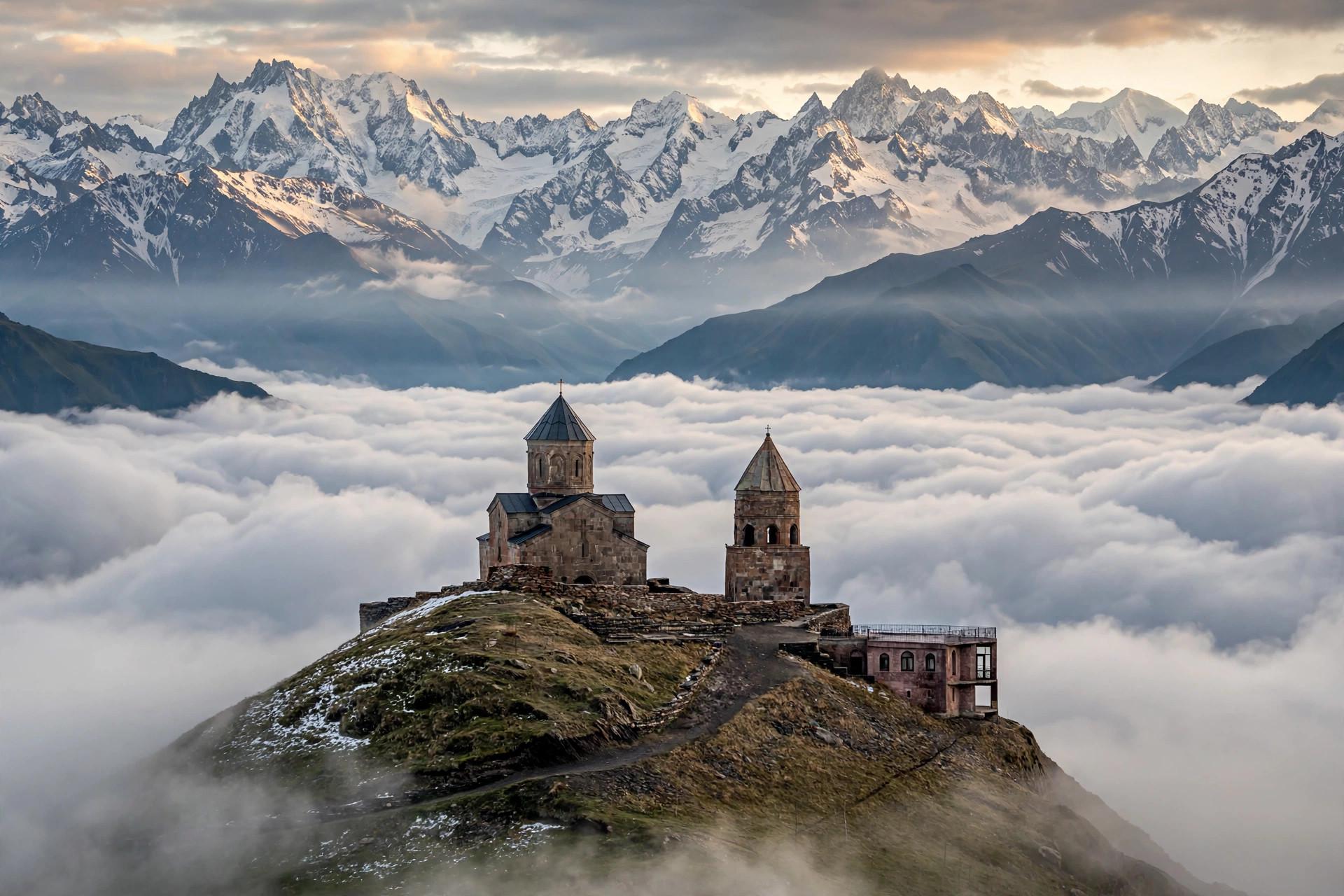
Gergeti Trinity Church floating above the clouds, with Mount Kazbek behind it, is the image that sells Georgia. It’s also a very long day up a mountain highway — and on some days, the mountain is wearing clouds and you see none of it. The most famous day trip from Tbilisi is not automatically the right one for your trip.
Tbilisi happens to sit within day-trip range of mountains, wine country, ancient capitals, and cave cities — which is wonderful and paralyzing in equal measure. This guide is a decision framework: four questions that narrow the options, honest trade-offs for each destination, and the transport question (guided tour, self-drive, or public transport) answered per trip.
Sign up for monthly travel guides
The short answer: four questions pick your trip
- How much time do you have? Half a day → Mtskheta. A full day → Kakheti or Uplistsikhe/Gori. A long full day, back after dark → Kazbegi.
- What’s the season and the forecast? Kazbegi is weather-dependent — the whole point is the view. Kakheti works year-round; Mtskheta and Uplistsikhe are fine in any season.
- How’s your mobility? Mtskheta is the easiest day. Kazbegi involves altitude and some walking; Uplistsikhe’s cave city is uneven rock with steps.
- What do you actually want — mountains, wine, or history? Be honest here. The “must-see” trip you endure is worse than the second-choice trip you enjoy.
Quick match: mountains → Kazbegi. Wine → Kakheti. Easy history → Mtskheta. Deep history → Uplistsikhe and Gori.
Kazbegi (Stepantsminda): the big mountain day — if the weather cooperates
The pitch is simple: the Georgian Military Highway climbs through the Caucasus to Stepantsminda, where Gergeti Trinity Church sits on a hilltop at about 2,170 meters, with 5,047-meter Mount Kazbek behind it. On a clear day it’s one of the great views in Europe. The drive itself is part of the experience — gorges, viewpoints, the Russia–Georgia Friendship Monument.
The catches are real. It’s a long day: several hours each way, so you’re trading a full day of your Tbilisi stay for it. The famous view is entirely weather-dependent — low cloud can hide both the church backdrop and the peak, and there’s no refund on the day. The mountain road is winding, and in winter the pass can be difficult or closed, so this is primarily a late-spring-to-early-autumn trip. The altitude is noticeable if you’re sensitive to it, though most visitors feel nothing worse than getting winded on the uphill walk to the church.
Verdict: go if mountains are the reason you came to Georgia, check the forecast the night before, and treat a cloudy day as a sign to pick something else — not a reason to go anyway and hope.
Pack for two weathers on this one: the valley floor can be warm while the church hilltop is windy and cold, even in midsummer. Layers beat a single jacket, and sturdy shoes make the uphill walk to the church far more pleasant.
Kakheti: the wine region, best done unhurried
Georgia claims 8,000 vintages of winemaking, and Kakheti is where that history is a living industry: family wineries, qvevri (clay vessel) cellars, and the hilltop town of Sighnaghi with its wall and Alazani Valley views. A wine day here is less sightseeing, more slow tasting — which is exactly the point.
The catch is the driving question, and it answers itself: a wine region is the one day trip you should not self-drive. Guided tours are the natural fit here — tastings are the activity, and the region’s wineries are spread out enough that a driver who knows the route earns their keep. It’s a full day, not a half-day, and the autumn harvest season (rtveli) is the richest time to visit but also the busiest — book ahead if you’re going then.
Mtskheta: the half-day history trip
Georgia’s ancient capital sits a short drive from Tbilisi: the Svetitskhoveli Cathedral, the Jvari Monastery on its hilltop above the river confluence, and a small old town of souvenir streets and bakeries. It’s the easiest worthwhile day out of the city — minimal planning, minimal time, real history.
The catch is scale. A few hours is genuinely enough; there’s no full day here unless you’re the type to read every plaque. That makes Mtskheta the perfect pairing trip — a slow morning in the city, Mtskheta in the afternoon — or the right answer when you have one free half-day and don’t want to spend it in transit.
Sign up for monthly travel guides
Uplistsikhe and Gori: the history-heavy long day
Uplistsikhe is a rock-hewn cave city carved into a cliff above the Mtkvari river — streets, halls, and a theater cut from stone, occupied from the early Iron Age. Pair it with Gori (the Stalin Museum is the draw, love it or loathe it) and you have a full day of deep history.
Two catches. First, mobility: Uplistsikhe is uneven rock, steps, and slopes with limited handrails — it’s genuinely demanding for anyone with knee or balance issues, and there’s no accessible alternative route through the site. Second, the payoff is intellectual rather than scenic: if ancient history isn’t your thing, this is a long day for a “huh, interesting.” History buffs will love it; everyone else should pick Kazbegi or Kakheti.
Guided tour vs. self-drive vs. public transport: the transport decision
This is the second decision after the destination, and the right answer varies by trip:
Guided tour. Best for Kakheti (tastings make self-driving a non-starter) and Kazbegi (the logistics — timing, viewpoints, the final climb — are handled). You pay for not thinking, and on a short trip, not thinking is worth a lot. The trade-off is the fixed itinerary and the group pace.
Self-drive. Maximum freedom: leave when you want, stop where you want. Best for Mtskheta (easy roads, short distance) and workable for Uplistsikhe. The catches: Georgian mountain driving is assertive by most visitors’ standards, rural signage can be thin, and rental terms need a close read — our rental car fee checklist covers the charges that ambush people at the counter. Do not self-drive a wine-tasting day.
Public transport. Marshrutkas (minibuses) connect Tbilisi to all four destinations and cost a fraction of a tour. The trade-off is flexibility: departures are infrequent, returns are early, and you’ll spend the day on someone else’s schedule with no stops at the viewpoints that make Kazbegi worth it. Fine for Mtskheta; a false economy for Kazbegi.
If you like building days around what’s beyond the obvious stops, our guide to Barcelona beyond the main sights applies the same thinking — the second-tier stop is often the better day.
A note on seasons
Kazbegi is the season-sensitive one: late spring through early autumn gives you the best odds of clear views and an open road; winter makes it a gamble. Kakheti runs year-round, with the autumn harvest as the peak experience. Mtskheta and Uplistsikhe are fine in any season — though Uplistsikhe’s rock paths are slippery when wet or icy, so check conditions in winter.
TripBuddy may earn a commission when you book through links on this page, at no extra cost to you.
Once you’ve picked your trip, browse bookable experiences on TripBuddy and lock in the day before it fills up.
Want one practical, money-saving travel guide like this each week? Join the TripBuddy newsletter and get the next one first.
Last reviewed: September 14, 2026